
THE CRC SCREENING CHALLENGE
Colorectal cancer needs a multifaceted approach to close the screening gap
SCREENING URGENCY
There is significant risk in waiting to screen for CRC1
Colorectal cancer (CRC) is the second-leading cause of cancer death despite being the most preventable cancer1,2
Timely CRC screening and early detection are essential to help reduce mortality rates and potentially save lives3

Many eligible patients with early-stage CRC have no symptoms, making proactive screening the only way to achieve early detection of CRC4

Unfortunately, more than half of eligible patients are diagnosed with regional or distant CRC1*
91%
Stages I, IIa, IIb (Localized)
73%
Stages IIc, III (Regional)
13%
Stage IV (Distant)
Based on a study from the American Cancer Society (ACS)
published in the Journal of the American Medical Association (JAMA)
Adults under 50 are at increasing risk of CRC-related mortality6
CRC is now the:
#1
cause of cancer mortality in adults under 506

Of the 5 leading causes of cancer-related mortality, only CRC has increased among adults under 50 since 2005.6

Nearly 3 out of 4 patients under 50 diagnosed with CRC have advanced disease.6,7

View the study. Leading cancer deaths in people younger than 50 years. JAMA. 2026.

Major CRC screening guidelines now recommend CRC screening starting at age 45 instead of 50 for those considered average risk.3,8‡§
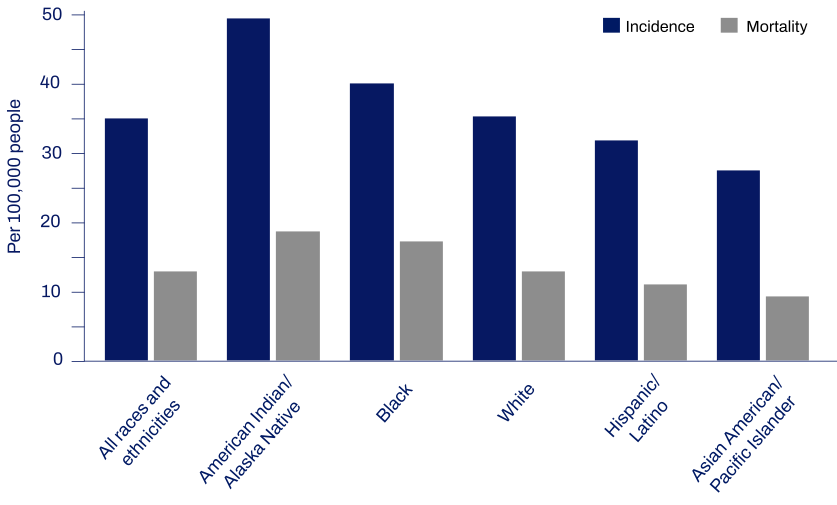
Hispanic adults face low CRC screening rates, with only 53% of eligible adults having screened.7
THE COLONOSCOPY CHALLENGE

Barriers like a lack of time or discomfort with colonoscopy might stop patients from getting screened for CRC.9
And with ~60 million average-risk patients eligible to screen, there are not enough GIs to perform all the colonoscopies even if barriers could be overcome.10
Dr Vega has been compensated for sharing his expertise and consulting for Exact Sciences.
Screening needs exceed capacity—relying on a colonoscopy-first approach leaves patients behind11
The number of screening colonoscopies could take ~8 years to complete and leave 90% of CRC cases undiagnosed in the first year.11¶

Provider volunteered his expertise.

When patients don’t follow through with screening, they may be at higher risk of failing to detect and prevent CRC when it is most treatable.1,2
THE EXACT SCIENCES SOLUTION
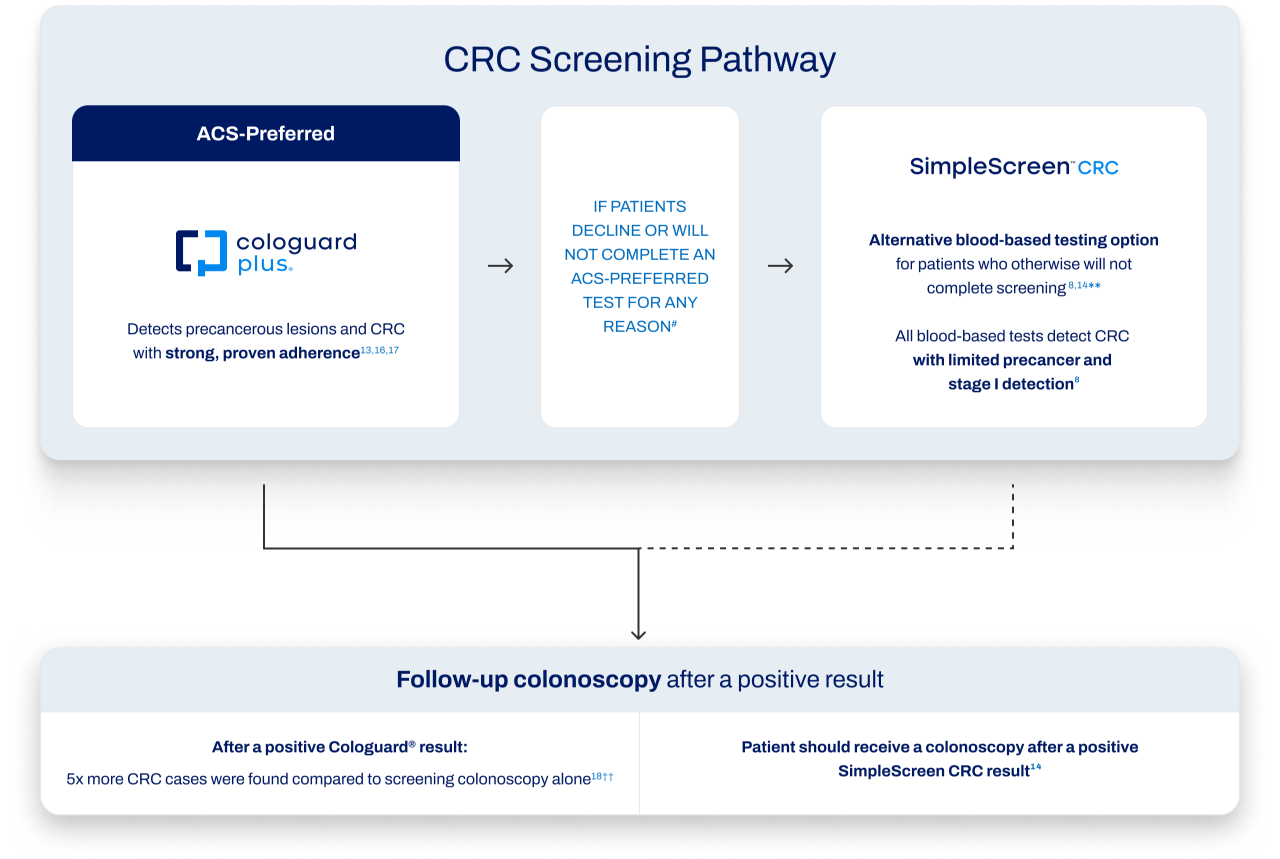
Lead with the ACS-preferred Cologuard Plus® test and reserve the SimpleScreen™ CRC test for those who would otherwise remain unscreened8

The Cologuard Plus test
Your first noninvasive choice with CRC sensitivity comparable to colonoscopy (95% according to a USPSTF review)3,13
Data were derived from multiple studies. No head-to-head performance data were captured.3,13

The SimpleScreen CRC test
A blood-based alternative for patients who will not complete ACS-preferred options like the Cologuard Plus test or colonoscopy8,14


Learn more about the 2026 ACS CRC screening guideline recommendations
Exact Sciences offers a simplified colorectal cancer screening pathway that prioritizes early detection and prevention8,13-15

Find out how the Cologuard test can help close the screening gap by overcoming barriers that may prevent colonoscopy completion.19
Offer the Cologuard test first and colonoscopy as needed to get more average-risk patients aged 45 years and older screened based on USPSTF-recommended modalities.3,10,13,19,20
High Cologuard performance and adherence help you screen more patients for CRC.10,13,19,20

According to the United States Preventive Services Task Force (USPSTF), average risk means3:
- No prior CRC diagnosis
- No prior inflammatory bowel disease diagnosis
- No prior diagnosis of adenomatous polyps
- No personal or family history of genetic disorders that put someone at high risk of cancer (eg, Lynch syndrome, familial adenomatous polyposis)

Communicate Cologuard eligibility and screening recommendations with ready-to-use patient letters from our Screening Communication Toolkit for HCPs.
Local CRC screening rates
What percentage of your area is up-to-date with CRC screening?
Important Information about the SimpleScreen™ CRC test
Intended Use
The SimpleScreen CRC test is a qualitative, in vitro diagnostic test intended to detect molecular signals associated with colorectal cancer. SimpleScreen CRC utilizes circulating cell-free DNA from plasma of peripheral whole blood collected in the SimpleScreen CRC blood collection kit.
SimpleScreen CRC is indicated for colorectal cancer screening in adults aged 45 years and older who are at average risk for the disease. Patients with a positive result should be followed by colonoscopy. SimpleScreen CRC is not a replacement for diagnostic colonoscopy or for surveillance colonoscopy in high-risk individuals.
Precaution
Based on data from clinical studies, SimpleScreen CRC has limited detection (57%) of Stage I colorectal cancer (64% when U.S. 2020 Census age-sex adjusted) and does not detect 87% of advanced precancerous lesions (86% when U.S. 2020 Census age-sex adjusted). One out of 10 patients with a negative SimpleScreen CRC result may have a precancer that would have been detected by a screening colonoscopy.
Contraindications and Limitations
The SimpleScreen CRC test is not indicated for patients who have the following:
- A personal history of colorectal cancer (CRC), advanced precancerous lesions (APL), or other related cancers
- Family history of CRC, defined as having one or more first-degree relatives (parent, sibling, or child) diagnosed with CRC at any age
- Positive result on another CRC screening method within the last six months, or:
- A fecal occult blood test (FOBT) or a fecal immunochemical test (FIT) within the last 12 months
- A FIT-DNA test within the last 36 months
- Personal history of any of the following high-risk conditions for CRC:
- Inflammatory bowel disease (IBD), including chronic ulcerative colitis (CUC) and Crohn’s disease
- Relevant hereditary cancer syndromes including but not limited to: hereditary non-polyposis colorectal cancer syndrome (HNPCC) or Lynch syndrome, familial adenomatous polyposis (FAP or Gardner’s), Familial Hyperplastic Polyposis, Peutz-Jeghers syndrome, MUTYH-associated polyposis (MAP), Cowden’s syndrome, Juvenile polyposis syndrome, serrated polyposis syndrome, Turcot’s/Crail’s syndrome, Cronkhite-Canada syndrome, or Neurofibromatosis
Providers should discuss the most appropriate screening test to use with patients depending on their medical history and individual circumstances. SimpleScreen CRC may produce a false negative or false positive result. A false negative result may occur when the SimpleScreen CRC test does not detect colorectal cancer or advanced precancerous lesions although a colonoscopy would identify either of these findings. A negative result does not guarantee the absence of colorectal cancer or advanced precancerous lesions, and patients should continue participating in colorectal cancer screening programs at the appropriate guideline-recommended intervals. A false positive result may occur when the SimpleScreen CRC test generates a positive result while a colonoscopy will not find colorectal cancer or advanced precancerous lesions.
Refer to the SimpleScreen CRC Provider Brochure for additional information about the benefits and risks of using the SimpleScreen CRC test.
Rx only. IVD.
Developed and manufactured by Freenome, LLC. Distributed by Abbott.
- Based on the percentage of cases diagnosed with CRC in stage II and stage III (39%) and in stage IV (22%).1
- Based on people diagnosed with CRC in stage I, stage IIa, or stage IIb between 2014 and 2020.1
- The USPSTF found adequate evidence that screening eligible patients aged 45 to 49 years provides a moderate benefit in reducing CRC deaths and increasing life-years gained. USPSTF-recommended screening modalities include stool-based tests or direct visualization tests.3
- The ACS makes a qualified recommendation for screening in eligible patients aged 45 to 49 years, indicating clear evidence of benefit of screening but less certainty about the balance of benefits, harms, and patient preferences. ACS-recommended screening modalities include high-sensitivity stool-based tests or structural (visual) examinations.8
- Rates are per 100,000 population, age adjusted to the 2000 US standard population, and exclude data from Puerto Rico. Incidence is adjusted for delays in reporting. All race groups are exclusive of Hispanic origin.7
- Based on modeling using an estimated 59.2 million adults eligible for CRC screening and an annual colonoscopy capacity available for screening of 6.3 million.11
- Stool-based tests, like Cologuard Plus, are among the ACS-preferred screening options, which also include direct visual tests.8
- Blood-based tests are not preferred by the ACS guideline at this time and should only be recommended to individuals who decline or have not completed a preferred screening option.8
- Based on cross-sectional data for >1.73 million colonoscopies performed between 2019-2022, CRC detection rates were 0.3% for screening colonoscopy compared to 1.5% for colonoscopy following a positive FIT-DNA test. The CRC detection rate for colonoscopy following a positive FOBT was also 1.5%; however, the GIQuIC database does not distinguish between the indication for positive guaiac FOBT or FIT.18
ACS=American Cancer Society; APL=advanced precancerous lesions; FIT=fecal immunochemical test; FOBT=fecal occult blood test; GI=gastroenterologist; GIQuIC=GI quality improvement consortium; HCP=healthcare provider.